
Matt Horne / Android Authority
Add Android Authority on Google:
You hear horror stories of people unwittingly incurring monstrous mobile bills when roaming abroad. Just recently, one Reddit user was horrified to find that AT&T had clobbered them with a $53k charge, after an eight-day European trip they expected to run them about $100 in roaming fees. You tend to feel sorry for these people, while also having lingering thoughts that they’ve been dealt a very tough life lesson. Thankfully, my own roaming-fee surprise involved considerably fewer zeroes. I only incurred about $20 in roaming charges, so not a big hit, but what bothered me was that I’d done everything right to avoid using mobile data. At least, I thought I had.
How do you manage mobile data while traveling?
107 votes
You might be thinking I’m just as culpable, and maybe lucky I wasn’t charged more. I can assure you that wasn’t the case. I hadn’t forgotten to switch something over after landing, and this wasn’t a travel eSIM taking a few seconds to wake up. In fact, I wasn’t trying to use data at all. I live outside the country of my home network, and that SIM sits in a separate phone on my desk. Mobile data and roaming are switched off in the device settings, plus the phone is always connected to my Wi-Fi network. I rarely even touch the device and don’t use it to contact anyone, to the point that it’s more of a paperweight than a phone. Despite all that, I was hit with phantom roaming charges twice in three months.
So what happened? And, more importantly, how can you stop it from happening to you?
Where did the phantom roaming charges come from?

Sanuj Bhatia / Android Authority
The first charge appeared on my bill a couple of months ago. My carrier had recorded a tiny amount of roaming data usage — well under 200KB — and that was enough to trigger its full daily roaming fee. I checked my phone because the obvious explanation was that I’d somehow left something switched on, but both mobile data and data roaming were disabled.
I grumbled to myself and shrugged it off, but then it happened again two months later. Another minuscule amount of data and another full day’s roaming charge. Oddly, both incidents happened on the final day of the month. In any event, it wasn’t about the money anymore. I now knew this wasn’t a one-off occurrence, and I wanted to stop it from happening again.
I contacted my carrier to ask what was going on. The agent could see both events and told me that, on each occasion, my phone had connected to mobile data for only a fraction of a second. Apparently, that blink-and-you’ll-miss-it connection was enough to earn me a full day’s roaming fee. I’m confident I didn’t enable data on either occasion, and given that the phone spends almost its entire life sitting untouched on my desk and connected to Wi-Fi, there wasn’t much opportunity for an accidental scroll on mobile data. Even if I’d accidentally flicked mobile data on for a moment, roaming was still disabled in the device settings, and vice versa. Furthermore, the data usage on my device was showing as zero. Not 0.01MB or anything like that, nada.
The data usage on my device was showing as zero.
Naturally, the carrier bore the brunt of my discontent — first the chatbot, then an agent, then that agent’s supervisor. They wouldn’t reverse the charges, and I could tell they still felt I was to blame, though I eventually got a gift card to shut me up. I was disgruntled and wanted to blame the carrier, but the truth is, maybe neither I nor it was to blame.
So what caused those split-second connections? I still don’t know. One possibility is signaling or network registration traffic when the phone connects to a roaming partner, while carrier policies can also result in MMS or Wi-Fi-assisted services being treated as roaming data. Xiaomi even warns that this can happen with data roaming switched off. The home carrier, the local network, Android itself, or some interaction between them could all potentially be involved.
What I did find was that I’m far from the only person to have seen something similar. Among other examples, one Rogers customer said their Galaxy S24 Ultra used 0.01MB of roaming data on several days despite data being switched off, triggering an $18 daily charge each time. Another Pixel 9 owner reported being charged on random days during a trip, despite data roaming being disabled, with only 0.01 MB recorded each time.
I’d have loved to get to the bottom of it, but it almost doesn’t matter. Whatever was responsible for those tiny connections, my phone had still incurred phantom roaming charges despite being set up in a way I reasonably thought would prevent them. The more useful question was how to make sure it couldn’t happen again.
Make sure it doesn’t happen to you

Image of a Pixel phone with Android’s Quick Settings on it. Original photo by Joe Maring. Gemini Nano Banana Pro was used to modify the photo and place the screenshot on the screen.
There are a few brute-force ways to avoid phantom roaming charges. You can put the phone in airplane mode, disable the SIM, or just switch the thing off entirely, though even that didn’t work for the aforementioned Redditor. Some carriers also let you set a spending limit to zero, which can be another useful safety net against unexpected charges.
The problem is that these options are only effective provided you don’t actually want your phone to behave like a phone. Airplane mode or disabling the SIM can prevent you from receiving verification texts or important calls from home, while spending limits are a safety net — not a target to hit. If your goal is specifically to stay reachable while making roaming data impossible, a more targeted approach is better.
The better solution, if your carrier offers it, is to block data roaming at the account level. That’s different from simply switching off data roaming on the phone. Instead of asking the handset not to use roaming data, you’re telling the carrier not to allow roaming data on the line in the first place.
A provider-side data-roaming block is the extra lock on the door.
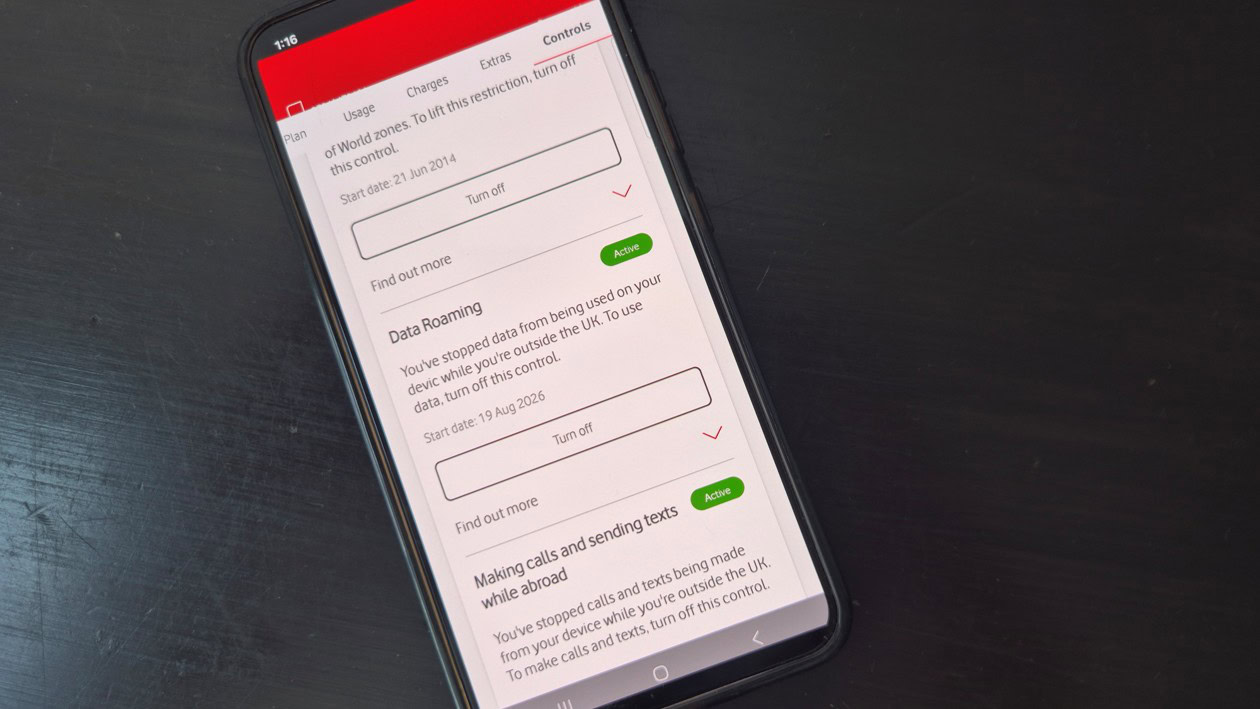
That’s what I eventually did. My carrier lets me place a data roaming bar on the account while still allowing calls and texts abroad. In my case, that means the phone can sit there connected to Wi-Fi and still receive the odd verification message or emergency call, but it shouldn’t be able to sneak even a few kilobytes of mobile data onto the bill. Even if it did, the carrier would have to accept the failure is on its end.
It’s worth checking how your own carrier handles this, because the exact controls and terminology will vary. The big carriers will usually allow you to do it in the app. But if you’re heading abroad and want to be absolutely sure mobile data can’t trigger a roaming fee, I wouldn’t rely on the phone toggle alone. A provider-side data-roaming block is the extra lock on the door.
Thank you for being part of our community. Read our Comment Policy before posting.