Most Linux advice targeted at newcomers starts and ends with “just pick Ubuntu or Linux Mint,” but I find that to be an oversimplification. However, at the same time, I do understand that it’s not helpful to overwhelm someone with the hundreds of distros out there. So, we’ve developed a quick cheat sheet that walks you through a dozen beginner-friendly distros and shows how they compare across the four key areas that matter for a Linux newcomer. This should help you decide for yourself instead of simply listening to someone else’s opinions.
The cheat sheet is shared at the end of the article. I’ve gone over the concepts described in the cheat sheet first so you can understand it better.
What hardware will you be installing it on?
Linux might run on anything — but your distro won’t
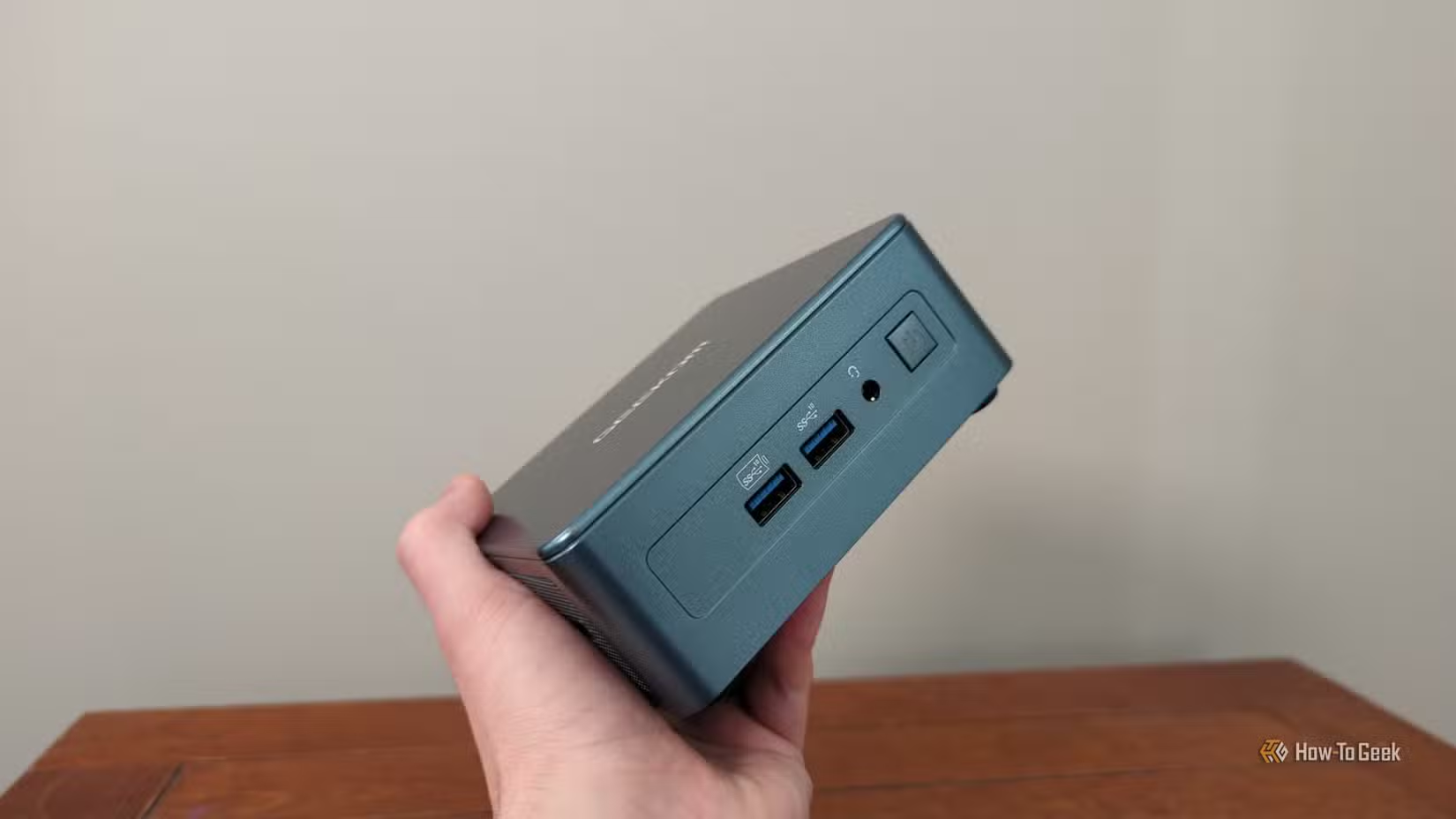
You’ve probably heard that Linux runs on almost anything and that it’s one of the best ways to breathe new life into an old system. While that’s technically true, not all distros support all hardware.
Let’s start with the CPU. The most common architecture right now is 64-bit (x86-64), used by Intel and AMD PCs, and every mainstream distro supports it — including Ubuntu and Fedora. However, if you’re using an older 32-bit system, your options are fairly limited. At the time of writing, antiX, Alpine, Q4OS, and Puppy Linux are a few reputable distros that still support 32-bit systems.
Then there’s ARM. Again, only a handful of distros are available for ARM, but fortunately, the list includes most of the popular names, such as Ubuntu and Fedora. Ubuntu has official images for 64-bit ARM systems, including the Raspberry Pi. Fedora ships aarch64 images, as does Fedora Asahi Remix — the go-to option for Apple Silicon Macs. Also, if you prefer Arch, you’ve got Arch Linux ARM and Manjaro ARM.
Then there’s the question of reviving old hardware. It’s true that many Linux distributions are lighter on system resources than Windows, but not all Linux distros are equally lightweight. For example, Ubuntu 26.04’s system requirements call for a 2 GHz dual-core processor and 6GB of RAM, whereas Xubuntu asks for just 1GB of RAM and any Intel or AMD 64-bit processor.
Finally, NVIDIA support on Linux has historically been a bit complicated, although things have improved considerably in recent years. Still, for the best performance and compatibility, you’ll want to install the proprietary NVIDIA drivers. Some distros, such as CachyOS and Garuda Linux, make this easy by offering them during the system installation. Others have them in their official repositories, but you’ll need to install them manually. Fedora is a little more complicated since its official repositories don’t include the proprietary NVIDIA drivers — so you’ll need to add the third-party RPM Fusion repository before installing them. That makes Fedora harder to recommend for folks running NVIDIA GPUs.
How do you want the distro to look and feel?
This is more important than the distro choice
Linux distros aren’t limited to a single desktop configuration like Windows or macOS. Instead, the overall desktop experience and many core system apps, such as Settings and the file manager, depend on the desktop environment. As a result, two very different distros — say, Kubuntu and CachyOS — can look similar because they both use the same desktop environment: KDE Plasma in this case.
Now, there are literally dozens of desktop environments out there. You can check out this article, where I ranked the 10 most popular desktop environments, to get an idea of how they look and feel. However, if you’re looking for some quick recommendations, here are my top picks:
- Cinnamon: If you’re looking for a basic Windows 7-like desktop experience.
- KDE Plasma: A highly customizable Windows-like experience for power users.
- GNOME: A different user experience focused on virtual desktops. It’s somewhat macOS-like if you’re a heavy Mission Control user.
I personally think that the choice of desktop environment is the more crucial decision for Linux newcomers, as it’ll determine the interface you interact with on a daily basis. As such, my advice is to first decide which desktop environment you want to use and then pick a distro that ships with it.
Now, it’s worth mentioning that you can technically switch desktop environments after installing a distro. However, doing so can create configuration conflicts that lead to bugs, and cleaning up the resulting mess is usually more technically demanding than it should be. As such, it’s far easier to pick a distro that ships with your desired desktop environment and save those experiments for when you’re more comfortable troubleshooting Linux.
How often do you want to update the distro?
Some systems ask for your attention daily — Others leave you alone for years
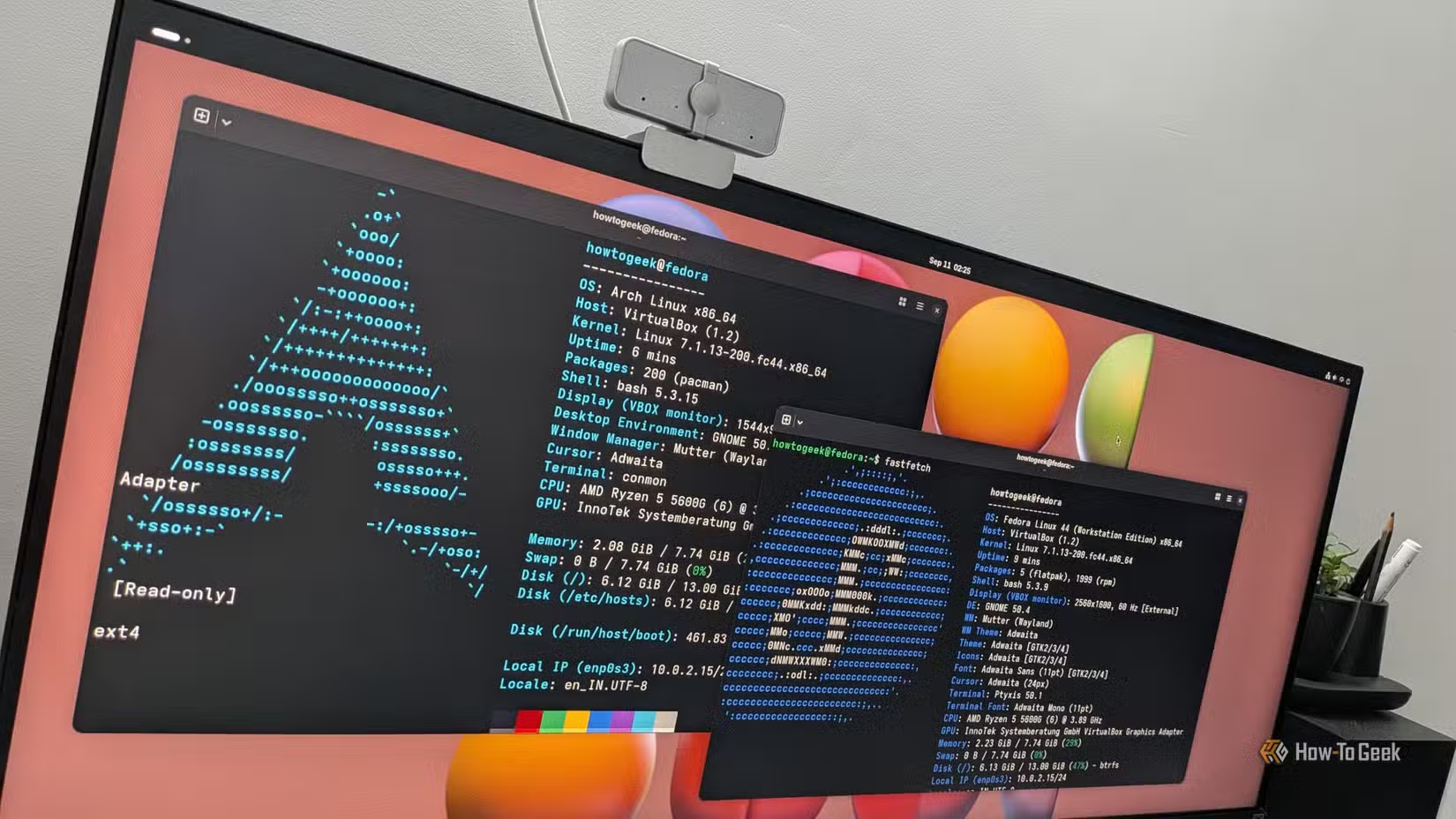
Your choice of distro directly affects how much time you’ll spend updating and maintaining it.
If you’re not a fan of Windows updates and just want your system to stay the way it is, you should be looking at stable-release distros like Ubuntu, Linux Mint, and openSUSE Leap. These release a new version every several months to every couple of years, and each release is supported for a good stretch afterward.
For example, a new Ubuntu LTS release comes out every two years and is supported for five years. This means you don’t need to worry about a major upgrade for half a decade, making Ubuntu a great option if you prioritize stability — but not so much if you prefer quick access to the latest bells and whistles.
With stable-release distros, you still get routine security updates. It’s the major feature updates and system redesigns that are reserved for major version upgrades.
At the other end of the spectrum, you have rolling-release distributions — most Arch-based distros, openSUSE Tumbleweed, and Debian’s Sid branch. Here, package updates land as soon as developers ship them, so you’ll see new updates practically every day. I’ve personally experienced 20 package updates waiting just minutes after updating my Arch system.
That said, you don’t necessarily have to update your packages every day. You can maintain a weekly or every-other-week update schedule. But don’t wait too long, because if your system packages become too outdated, it might break the entire update process. As such, these distros are ideal for folks who want to live on the bleeding edge, get quick access to new software, and don’t mind the overhead that comes with routine system maintenance.
Now, I should mention that Fedora has managed to carve out a nice middle ground in this tug-of-war between stability and having access to newer software. New versions come out every six months in April and October, and each release ships with packages that are relatively cutting-edge at the time of release. So you only need to upgrade twice a year, and you’re never more than six months behind. The Fedora developers also do an excellent job of testing the software to iron out most bugs, making Fedora one of the more stable distros available.
Do you want something minimal or pre-configured?
Blank slate or fully furnished

The whole point of a Linux distro is to prepackage everything for you, so you can just install it and start working. However, not everyone wants the same level of software and configuration out of the box. That’s why some distros give you nothing more than a terminal, while others come preloaded with everything you might need.
On the minimal end of the spectrum, we have vanilla Arch and Debian. These give you just the bare essentials — everything else is on you to configure. That’s how you build a hyper-personalized system, but it also means you need to be tech-savvy enough to have opinions about every layer of your OS. As such, these minimal distros are rarely recommended to newcomers.
Next, we have the general-purpose distributions like Ubuntu and Linux Mint. Here, everything is preconfigured to give you a sensible, generic base — a desktop, a browser, the essentials — and you’re expected to customize it from there based on your specific workflow. This is similar to setting up Windows or macOS.
Then there are hyper-configured distributions, fine-tuned for specific use cases. Here, you have options like Garuda Linux, which is preconfigured for Linux gaming with all the necessary packages and tweaks you might need. For more serious work, you’ve got Kali Linux, which comes withthe necessary cybersecurity tools and system-level optimizations.
If you know you’ll use Linux for a very specific use case, one of these preconfigured distros can save you a lot of setup time.
How-To Geek’s Linux distro cheat sheet
Find the perfect distro to start your Linux journey

Now that you know the criteria for picking the perfect distro, let’s streamline the process. Here are 12 distros worth considering as a Linux newcomer, charted against everything above, so you can choose the one that best fits your needs and requirements.
|
Distro |
32-bit architecture support |
ARM support |
Proprietary NVIDIA driver support |
Default Desktop Environment |
Heaviness |
Update cadence |
Minimal or bloated |
|---|---|---|---|---|---|---|---|
|
Ubuntu |
❌ |
✅ |
Manual installation (easy) |
GNOME (macOS-like) |
Heavy (GNOME with modifications) |
Stable — new version every 6 months, LTS every 2 years |
General purpose |
|
Fedora |
❌ |
✅ |
Manual installation from third-party repo (moderately technical) |
GNOME by default, spins for other desktops |
Moderate (vanilla GNOME) |
Stable but current — every 6 months, ~13 months support |
Open Source purist |
|
Linux Mint |
❌ |
❌ |
Manual installation (easy) |
Pick at Download: (All Windows-like) |
Moderate to low based on DE |
Stable — follows Ubuntu LTS |
General purpose |
|
CachyOS |
❌ |
❌ |
Included out of the box |
Pick at install, KDE default |
Depends on DE (KDE default) |
Rolling |
Pre-configured with performance tweaks |
|
openSUSE |
❌ |
✅ |
Manual installation (easy) |
Pick at install |
Depends on DE |
Leap = stable, Tumbleweed = rolling |
Fairly complete, with YaST tools |
|
Zorin OS |
❌ |
❌ |
Included out of the box |
Custom GNOME (Windows-like) |
Moderate (custom GNOME) |
Stable — Ubuntu LTS base |
Heavily pre-configured for Windows switchers |
|
Manjaro |
❌ |
❌ |
Manual installation (easy) |
Pick at Download (KDE, GNOME, Xfce) |
Depends on edition |
Rolling — Arch packages held back ~2 weeks |
General purpose |
|
Xubuntu |
❌ |
❌ |
Manual installation (easy) |
Xfce |
Very light (~500 MB RAM) |
Stable — every 6 months + LTS |
General purpose |
|
Garuda Linux |
❌ |
❌ |
Included out of the box |
Pick at Download, KDE default |
Heavy (KDE + heavy theming) |
Rolling |
Heavily pre-configured, gaming-tuned |
|
Fedora Asahi Remix |
❌ |
✅(M1/M2 Macs only) |
N/A |
KDE Plasma, GNOME available |
Moderate (KDE flagship) |
Stable — rebases to Fedora releases |
Pre-configured for Mac hardware |
|
Q4OS |
✅ |
✅ |
Manual installation (easy) |
Pick at Download: (Windows-like) |
Very light if using Trinity (~256 MB RAM |
Stable — follows Debian |
General purpose |
|
Puppy Linux |
✅ |
❌ |
Manual / varies by build |
Varies by build (JWM + ROX) |
Extremely light (runs in RAM) |
Independent, per-build releases |
General purpose |