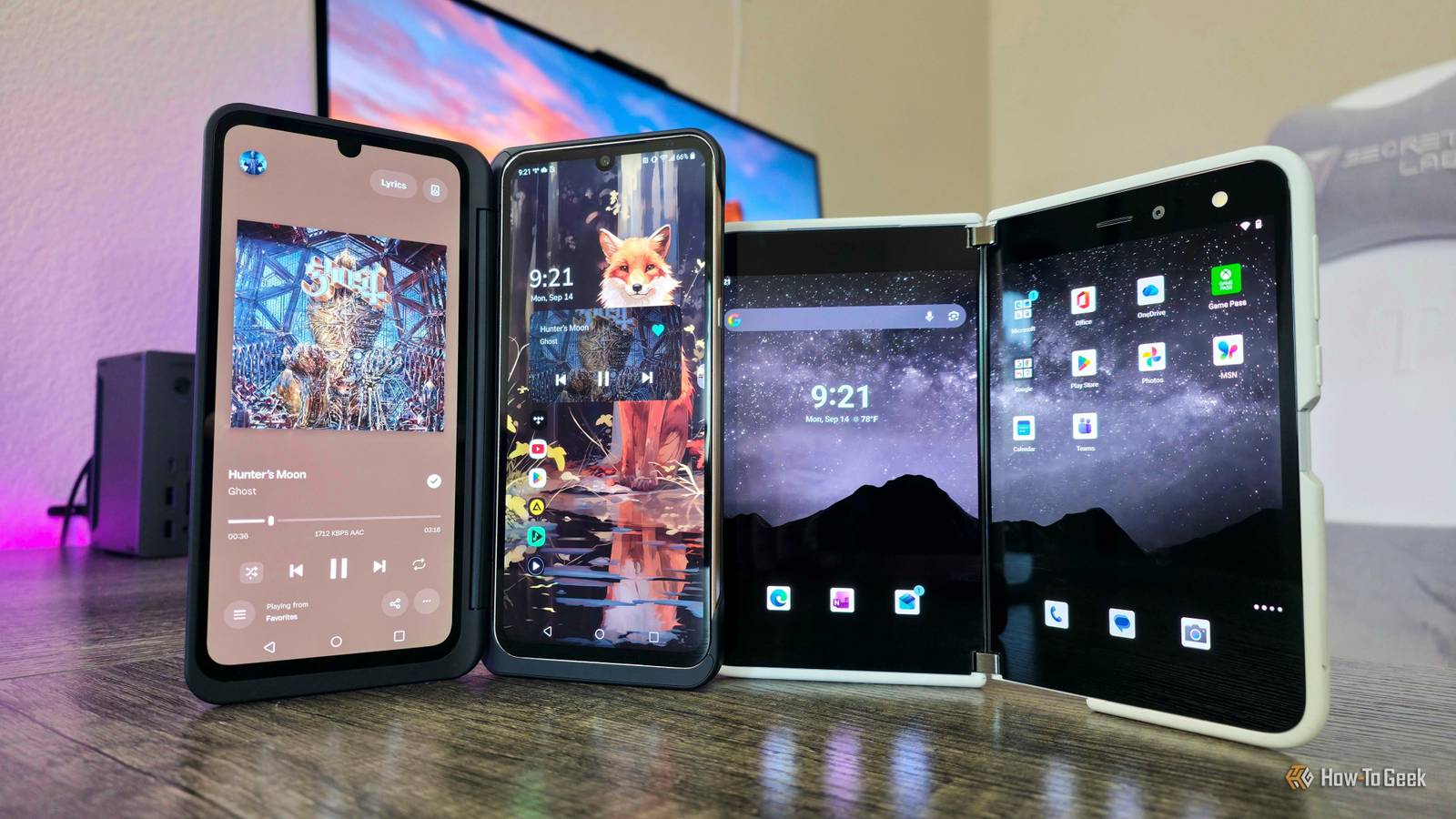
The unstoppable rise of foldables has slowed the homogenization of smartphones with new form factors and designs, but early in the foldable era, dual-screen smartphones (two separate displays connected by a hinge) seemed like an alternative to traditional slabs.
That period was short-lived, though, as dual-screen smartphones quietly faded into obscurity while foldables grew in popularity. To be frank, it’s completely understandable that foldables won that short-lived war, but I decided to dig up my original Surface Duo and the LG V60 ThinQ’s Dual Screen case to see whether dual-screen smartphones had any meritafter all.
The long-forgotten potential of dual-screen phones
Using the Surface Duo and LG V60 years down the line
At first glance, it seems like dual-screen phones were simply the stop-gap before foldable technology became refined enough to reach the masses. The promises are similar: take the portability and convenience of a smartphone and the multitasking power of a PC, and build a device versatile enough to deliver both.
In my opinion, though, the real promise of dual-screen smartphones was intentionality. Foldables like the Samsung Galaxy Z Fold7 I keep in my pocket and the newly announced iPhone Duo are always ready to play the part of a normal smartphone, and even when opened can be simply used like, well, a larger smartphone.
Dual-screen devices like the Surface Duo, on the other hand, encourage more intentionality when using them because of how they’re fundamentally designed to function. The added step of having to open the Surface Duo to use it at all (and the added step of folding the phone all the way around if you want a single screen) makes you question if you actually need your smartphone right now, reducing wasted time checking for notifications, doomscrolling on social media, or mindlessly swiping through your apps out of boredom.
Two separate displays, rather than one larger whole, also encourage multitasking. Foldables are fully capable of the same, of course, but many people often default to having one app open at a time anyway. Multitasking is natural and expected with the Surface Duo, and my time with it as my primary smartphone motivated me to be more creative with my usage and more productive in general.
Apple apparently understands this, too, as the iPhone Duo is the first foldable I’ve seen that properly takes cues from the Surface Duo—and I don’t mean the name or passport-like shape. Details like your homescreen being able to live on one side of the screen or links and buttons opening the relevant app on the other side show that Apple approached the iPhone Duo’s inner screen not as a single surface, but as a duo of seamlessly connected screens that can also perfectly function as one large screen. Even the iPhone Duo’s gestures remind me of the intuitiveness of the Surface Duo.
These are subtle things, but they really do change how you use your smartphone. The Surface Duo was honestly a mediocre phone even when it was brand-new, but I felt my smartphone usage was healthier and my multitasking more efficient with the dual-screen Duo than with the far more capable foldable I replaced it with. Using the Surface Duo and LG V60 ThinQ with its dual-screen case all these years later has reminded me of that.
Foldables aren’t a 1:1 upgrade over dual-screen phones
It’s clear how foldables killed the dual-screen dream, though
It’s easy to assume that dual-screen phones died solely because foldables are a one-to-one upgrade on every level, but that simply isn’t the case. Dual-screen smartphones have unique strengths beyond what I’ve already mentioned, especially in durability, cost, and comfort.
Dual-screen smartphones don’t need to worry about the fragility of a folding OLED display, the softness of the screen covering it, the crease that divides the middle, or the ridiculously complicated hinge that backs the entire display. Instead, it uses two traditional hard-glass displays connected by simpler hinges, which affect weight and thickness, long-term durability, and the cost of research, development, and production.
The Surface Duo may have cost a ridiculous $1,400 when it launched almost exactly six years ago, but that was still $600 less than the heavier, thicker, and far more fragile Samsung Galaxy Z Fold2 that released a week later. The Surface Duo is also lighter and thinner than the iPhone Duo that’s releasing in October — had dual-screen smartphones survived and enjoyed six years of innovation and competition, what could they look like today?
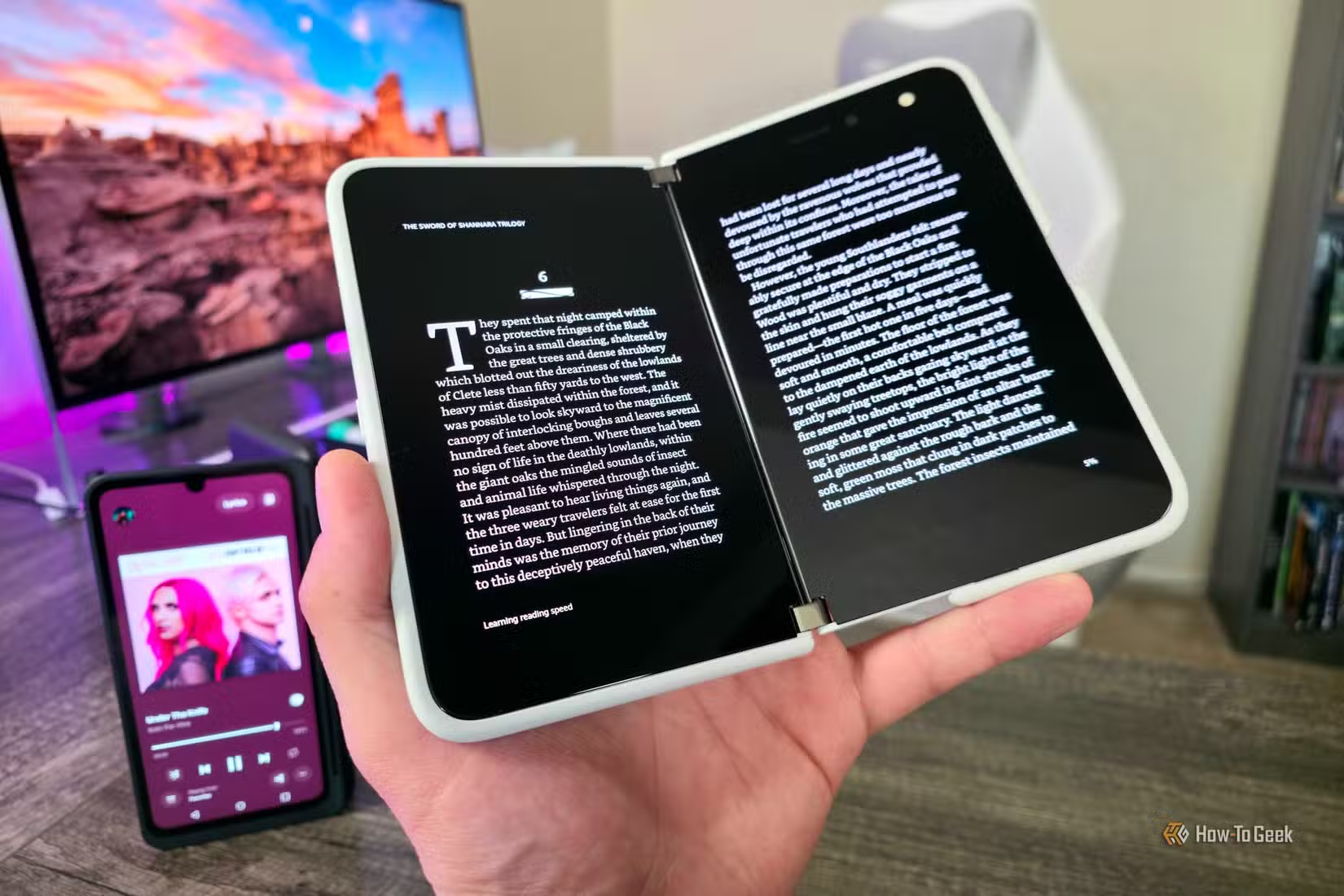
For me, the greatest benefit is comfort. Unlike foldables that prefer to be opened completely flat, the Surface Duo feels completely natural held like a book. Speaking of books, the Surface Duo still offers one of the best e-reading experiences of any device I’ve ever used because of its size, dual screens, and the way you hold it. Those thick bezels may be unsightly, but they also admittedly help with one-handed use compared to a foldable.
Foldables are obviously far better in many ways, especially with the way most people want to use their phones, but there’s still something I love about the Surface Duo past its half-baked software and terrible camera. The LG V60 ThinQ’s awkward dual-screen case and its ridiculous matching teardrop camera cutout (with no camera) also possess its own charm, especially since you could just remove the V60 from the case and use it as a traditional slab smartphone whenever you wanted to.
Dual-screen phones are dead, but I wish they weren’t
Don’t get it twisted: I’m not saying dual-screen smartphones are superior to foldables; I still prefer having a foldable in my pocket, but I do believe there’s still a place for dual-screen smartphones in today’s world. For example, a dual-screen version of the Samsung Galaxy Z Fold8 could be the spiritual successor to the Surface Duo, joining the Z Fold lineup at a far lower price point while offering all the benefits of the dual-screen form factor. Will it happen? Absolutely not… but I’d seriously love to see it.