
Google Tasks and Google Keep are two apps that I’ve used for as long as I can remember, but I’ve never been completely happy with them. That’s why I was so happy to stumble upon an open-source app that can replace both (and even work with them).
The app is plainly named “Tasks.org,” but it’s far more than just a task manager. In fact, it’s Google Keep that led me to it. I was looking for an app to replace some features that Google had recently removed from Keep. What I found was an app that could do much more than I bargained for.
Google Tasks and Keep have a weird overlap
I use them separately, but should I?
If you asked people at Google about which of its apps to use for making a list, you’d probably get conflicting answers. Tasks and Keep both include the ability to make lists, but with slightly different intentions. Tasks is geared toward to-do lists, while Keep lists are better for shopping and packing.
That’s exactly how I’ve been using the apps for a very long time. I keep my to-do list with reminders in Google Tasks and various shopping lists in Google Keep. The system has worked pretty well for me, thanks in large part to being able to access these apps from my Google Home speakers. However, things started to unravel earlier this year.
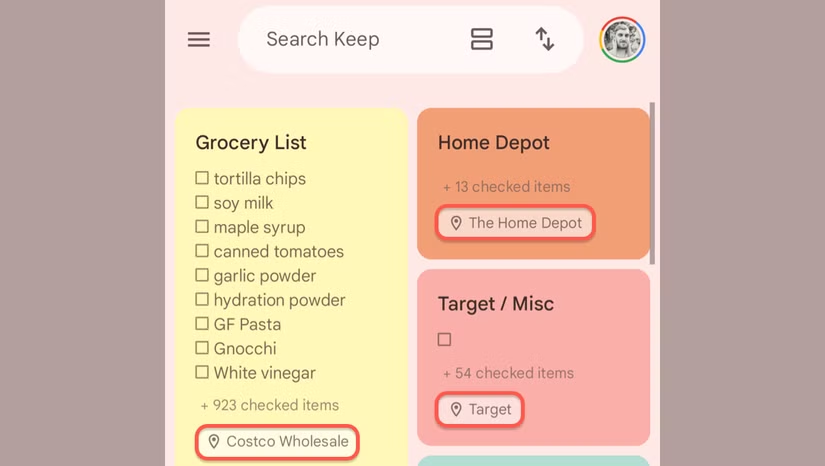
Google removed a feature that I absolutely loved in Keep: location-based reminders. It allowed me to attach specific store locations to their corresponding lists. Whenever I was in that store, the list would pop up in my notifications. This saved me countless times from forgetting to check my list while wandering around a store (I know, I know).
Anyway, the feature was removed without a replacement. Google moved any reminders that had been set up in Keep over to Tasks, which also does not have location-based reminders. I started to wonder why I was using these two separate apps.
Tasks.org solves a lot of problems
Free two birds with one key
I don’t want to make this entire article about Google, but the easiest way to imagine Tasks.org is by mushing the list functionality of Tasks and Keep together. It’s an app that works for to-do lists and checklists. Plus, it has location-based reminders that are even better than what Keep offered.
There are a couple of different ways to organize your lists in Tasks.org. The most typical way to do it is with separate lists. For example, a to-do list and various lists for shopping, packing, etc. Alternatively, you could put all your items in one big list and use tags to organize them. I mentioned location-based reminders — places are essentially tags, too.
The latter is probably the better way to use Tasks.org. That’s because more emphasis is put on task creation than on the lists themselves. When you add a task or list item, you’re presented with a bunch of options right away: Start date, due date, priority, list, subtask, tags, reminder, location, and calendar. If this is too much, you can customize the options that appear.
That being said, I’ve organized Tasks.org with lists and locations. I have a “To Do” list for tasks, a catch-all “Shopping” list, and two store locations saved in the “Places” section. The To Do list is my default list — it’s where tasks go when I don’t do any manual categorization. This allows me to add to it very quickly.
For the shopping lists, I first select the store from the sidebar, then just make sure to select “Shopping” as the list when adding an item. This system allows me to select a store to see items for that location, or see all the items in one place in the Shopping list. For items that don’t need a specific store attached, I can simply add them directly to the Shopping list.
It works with Google, too
A nice way to ease the transition
I switched to Tasks.org as a way to ditch the Google equivalents, but you don’t have to do that. The app supports syncing both ways with Google Tasks (not Keep). If you connect your Google account, your Tasks lists are kept in sync, and every list you create in Tasks.org will also be in Google Tasks.
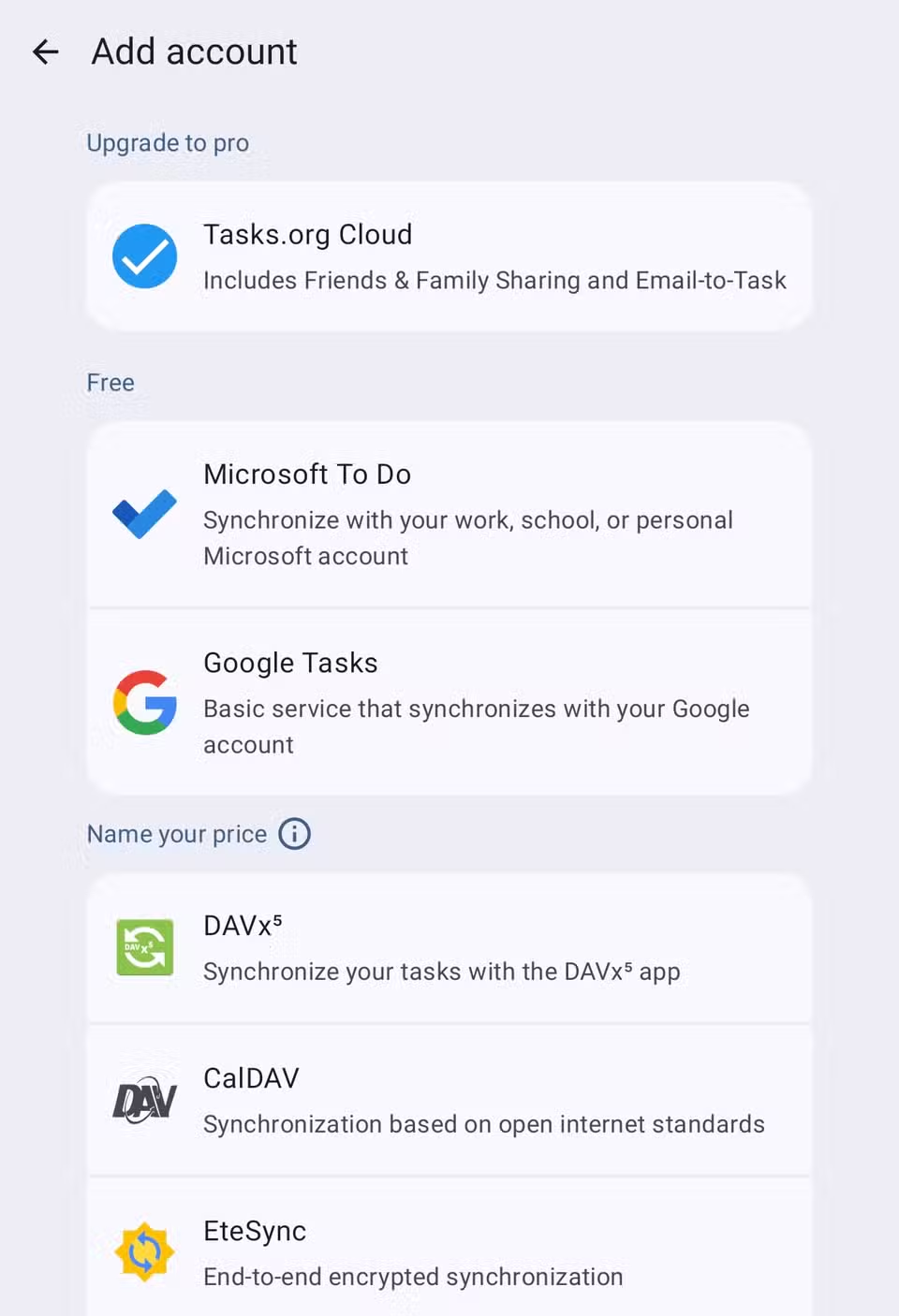
When I first started using Tasks.org, the Google integration made it easier to switch. It’s also a great way to continue using Google Home speakers and Gemini to add tasks since they’ll automatically sync over to Tasks.org.
Regardless of how you choose to use it, Tasks.org is a perfect example of how third-party apps are often so much more powerful than their big-name counterparts. All you have to do is be willing to give them a fair chance.